

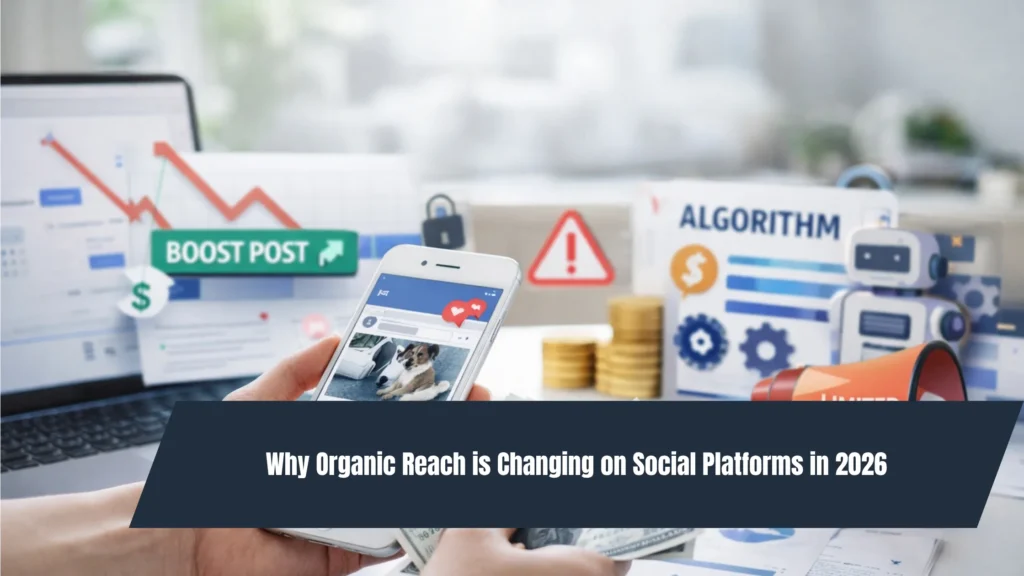
Social media has been changing for a few years now. By 2026 we can really see the change. Even companies that work with a Digital Marketing Agency in Calicut are seeing that they are not getting many people to see their stuff on social media without paying for it. This is happening on Instagram, Facebook, LinkedIn and TikTok.
It is getting harder for brands and people who make content to get people to see their stuff without paying for ads. This is because the rules that decide what people see on the media are getting smarter. People are using media in different ways now. Also social media companies are using intelligence to decide what to show people. They are trying to make more money from their platforms. Social media is. It is affecting organic reach. Organic reach, in the media, is what we are talking about here.
What is Organic Reach in Social Media?
Organic reach is when people see your posts without paid ads. It mainly comes from followers, shares, and recommendations. Earlier social media showed posts in time order. Now AI algorithms control what users see in their feed. These systems prioritize engaging and relevant content. Because of this, fewer people see posts naturally. Competition for attention on social media is very high. So organic reach has become much more difficult to achieve.
Why Organic Reach is Declining in 2026
Algorithm Prioritization of Paid Content
Social media platforms like to show paid advertisements and posts that people like and talk about because that is how they make money. This means that regular posts from pages do not get seen much as they used to. Only posts that people really like and share or are paid for as advertisements can reach a lot of people. This makes things hard for businesses that work with a Social Media Marketing Agency in Calicut. They have to figure out how to use posts and paid advertisements together in a good way.
AI-Driven Content Personalization
Social media now uses AI to show content people are most likely to enjoy. Apps like Instagram, TikTok, and YouTube Shorts study user behavior. They track what people watch, like, and share. They also notice how quickly users react to posts. Based on this, the system decides what appears on the feed. Content that gets fast engagement is shown to more people. Even good posts may not spread if they don’t get early attention. This makes feeds more personalized but less diverse.
Massive Content Saturation
Every second thousands of posts, reels and videos get uploaded to the media. This creates an overload of content. Now everyone is fighting for attention. Algorithms are getting more picky. They only show content that’s already popular. For medium businesses getting noticed without a plan is really tough. They need to optimize their content. The competition is high. Businesses need to find ways to stand out. They have to make sure their content reaches the people. This is the way they can get noticed in a crowded online space.
Shift in User Behavior and Attention Span
User behavior in 2026 has changed drastically. Attention spans are shorter, and content consumption habits are more fragmented. Instead of scrolling long feeds, users now prefer short-form videos, private communities, AI-curated content feeds, and interactive formats such as polls, quizzes, and live sessions. This shift reduces organic reach for static posts and increases demand for dynamic and engaging content formats.
Platform Monetization Strategy
Social media platforms are increasingly adopting an ad-first ecosystem. Organic reach is intentionally limited to encourage businesses to boost posts or run campaigns. Organic distribution now works as a teaser model where a post gets limited initial reach, performance is measured quickly, and platforms prompt paid promotion for scaling visibility. This makes paid ads almost unavoidable for businesses aiming for consistent reach and growth.
Key Terms Shaping Organic Reach in 2026
To better understand this ecosystem, it is important to recognize the major forces shaping visibility today. Algorithmic ranking systems determine what users see by analyzing engagement signals and behavior patterns. AI content personalization ensures every feed is unique to each user. Engagement-based distribution prioritizes posts that generate fast interaction. Social media advertising models now dominate platform revenue strategies. Content saturation and the attention economy define how limited user focus is divided across millions of posts.
How Businesses Can Adapt to Reduced Organic Reach
To succeed in this environment, businesses must move beyond traditional posting strategies and adopt a more structured approach. High-quality, intent-based content is now essential. Instead of posting frequently, brands must focus on content that solves real problems, builds trust, and encourages engagement. Content inspired by How to Craft Viral Social Media Posts That Drive Engagement performs well because it aligns with user psychology and platform algorithms.
Brand storytelling also plays a major role in visibility. Audiences today respond better to authentic, relatable, and human-centered content rather than overly promotional messages. Sharing customer stories, behind-the-scenes content, and educational insights helps build deeper connections with audiences.
Community building has become another critical strategy. Instead of relying only on public feeds, brands are now creating private communities on platforms like WhatsApp, Telegram, and Discord. This helps maintain consistent engagement regardless of algorithm changes.
Data-driven decision-making is equally important. Metrics such as engagement rate, watch time, click-through rate, and saves provide insights into what content actually works. This allows brands to refine their strategy based on real audience behavior rather than assumptions.
Educational content continues to perform strongly because it provides long-term value. Content such as The Value of Social Media Marketing for Building Brand Awareness helps establish authority and positions brands as trusted sources in their industry.
The Future of Organic Reach
Organic reach is not disappearing, but it is evolving into a more selective and intelligent system. Instead of mass exposure, platforms now reward relevance, engagement quality, audience retention, and niche authority. The future of social media will likely be driven by micro-communities and highly personalized content ecosystems rather than broad viral posts.
Frequently Asked Questions
Is organic reach completely dead in 2026?
No, organic reach is not dead. It is more selective now. Platforms still distribute content organically, but only to posts that show strong early engagement, relevance, and user interest.
Why do social media platforms reduce organic reach?
Platforms prioritize paid ads and high-performing content because it increases revenue and improves user experience by showing more relevant posts.
Which platforms have the lowest organic reach in 2026?
Generally, Facebook and Instagram have lower organic reach for business pages, while TikTok and LinkedIn still offer better organic visibility depending on content quality and engagement speed.
What is the best strategy to improve organic reach in 2026?
A combination of high-quality content, strong hooks, early engagement optimization, community building, and selective use of paid promotions works best for improving organic reach today.
Conclusion
The decline of organic reach in 2026 reflects a major transformation in the digital marketing landscape. Social media platforms are now AI-driven, ad-focused ecosystems where visibility depends on strategy rather than chance. For businesses, this shift presents both a challenge and an opportunity. Those who adapt by combining SEO, storytelling, paid campaigns, and community building will continue to grow despite algorithm changes.
