

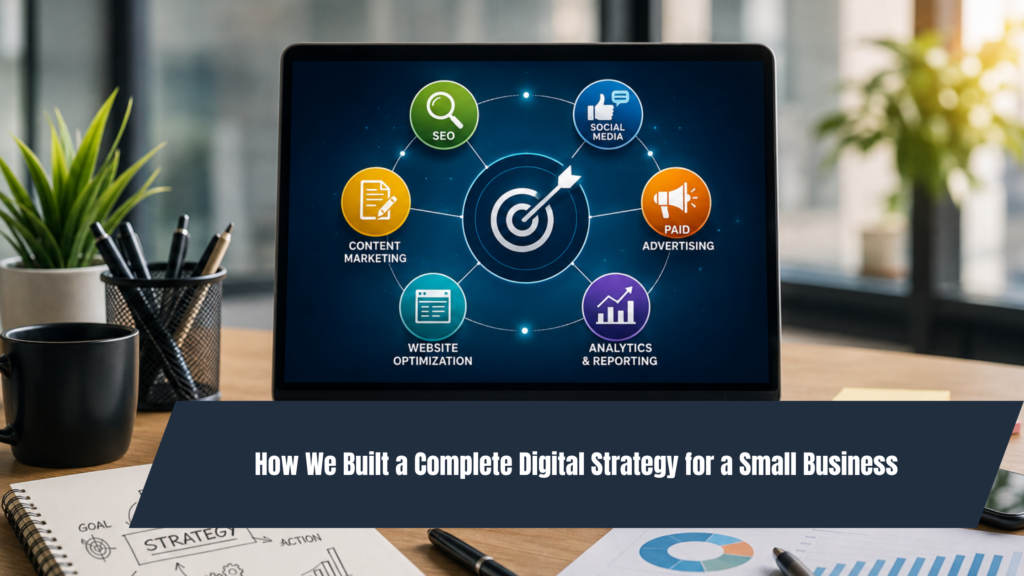
Running a small business today often means competing for attention both online and offline. Having a website or posting occasionally on Instagram is no longer enough. Customers may discover a business through Google, social media, an advertisement, or even a recommendation and then check its online presence before making a decision.
That is why a digital strategy for small business needs to be practical, focused, and connected to real business goals. Instead of trying every available marketing channel, we started by looking at what the business actually needed and where its potential customers were spending their time.
Starting With the Business, Not the Marketing Channels
One of the first things we looked at was the business itself.
Before deciding whether to invest more in SEO, social media, or advertising, it was important to understand what the business wanted to achieve. Was the priority more enquiries? More website visitors? More local customers? Better brand awareness?
These questions shaped the rest of the strategy.
A business that depends on local customers needs a different approach from an online store serving customers across India. Similarly, a service company may care more about qualified enquiries than the number of people visiting its website.
For businesses that need professional guidance, a digital marketing agency in Calicut, Kerala can help turn these business objectives into a practical online marketing plan.
Understanding Who the Business Wants to Reach
Once the business goals were clear, we focused on the audience.
We looked at where potential customers were located, what problems they were trying to solve, what they searched for online, and what might influence their buying decision.
This was particularly important for a Kerala-based business. Local customers may use location-specific searches, look for nearby businesses on Google Maps, or check social media before contacting a company.
Understanding these habits helped us decide which channels deserved attention and which could be avoided.
Looking at the Existing Online Presence
The next stage was to understand what was already working.
The website was reviewed from both a customer and search-engine perspective. We looked at the overall experience, page structure, content, mobile usability, loading performance, calls to action, and opportunities for better search visibility.
The business’s social media presence was also considered. Rather than looking only at follower numbers, we looked at the type of content being published and how the audience responded to it.
This kind of review gives a much clearer picture than starting a new campaign without knowing what has already been tried.
Building the SEO Foundation
SEO became one of the important long-term parts of the strategy.
The first focus was understanding the language customers actually use when searching for the business’s products or services. From there, relevant topics and search terms could be mapped to appropriate website pages.
On-page improvements included better page titles, headings, content structure, internal links, and clearer information for visitors.
Technical factors also mattered. A website needs to be accessible to search engines while providing a smooth experience on mobile devices and desktops.
For a business targeting customers in Kerala, local SEO can add another layer of visibility. Google Business Profile optimization, location-relevant pages, customer reviews, and useful local content can help a business appear when nearby customers are searching.
Creating Content People Actually Want to Read
Content was not treated as a way to simply fill the website with keywords.
Instead, we focused on questions and problems that potential customers might have before contacting the business.
A useful article can answer a simple question, explain a complicated service, compare available options, or help someone make a purchase decision. This approach also creates opportunities for AEO because well-structured answers are easier for search and answer systems to understand.
The same principle applies to social media. Instead of posting only promotional messages, businesses can share useful tips, demonstrations, customer experiences, product information, and insights from their industry.
Making Social Media Part of the Bigger Strategy
Social media works better when it supports the rest of the marketing plan.
For example, a useful blog article can become several social media posts. A product video can be used as an organic Reel and later tested as an advertisement. A frequently asked customer question can become both an FAQ on the website and a social media post.
This creates consistency without requiring the business to constantly come up with completely new ideas.
The important thing is to choose platforms based on the audience rather than trying to maintain every social network available.
Using Paid Advertising Carefully
Organic marketing can take time, so paid advertising can be useful when a business wants to reach a specific audience more quickly.
Google Ads can capture people who are already searching for a particular product or service. Meta advertising can help businesses introduce products to relevant audiences, generate enquiries, or bring previous website visitors back to the business.
We would not recommend simply increasing the advertising budget from day one. Testing different audiences, messages, creatives, and landing pages provides useful information about what actually works.
This is where professional digital marketing services in Calicut can bring together paid campaigns, SEO, social media, content, and website optimization rather than treating each service as a separate activity.
Turning Website Visitors Into Customers
Getting someone to visit a website is only half the job.
Once they arrive, the next question is whether the website makes it easy for them to take action.
A visitor should quickly understand what the business does, what makes it relevant, and what they should do next. Clear service information, simple navigation, strong calls to action, enquiry forms, WhatsApp options, and trust-building content can make a significant difference.
A good marketing campaign can bring people to the website, but the website needs to give them a reason to stay and take the next step.
Connecting the Customer Journey
The different parts of the strategy should work together.
Someone might first discover a business through an Instagram post. Later, they may search for the business on Google, visit the website, read a service page, and finally contact the company.
Another customer might search Google directly, visit a landing page, and send an enquiry.
These journeys show why SEO, social media, advertising, content, and website optimization should not be planned in isolation.
The goal is to create a consistent path from discovery to consideration and eventually conversion.
Measuring the Results
Once campaigns are running, we need to know whether they are actually helping the business.
For SEO, this can include organic traffic, search visibility, relevant keyword performance, and enquiries. Social media can be evaluated through engagement, reach, shares, saves, and website visits.
Advertising requires a closer look at clicks, cost per click, conversions, cost per lead, and return on advertising spend.
But the most important question remains simple:
Is the marketing helping the business generate better opportunities or sales?
A campaign can have thousands of impressions and still produce little business value. Measuring meaningful outcomes helps avoid making decisions based only on surface-level numbers.
What Makes a Digital Strategy Successful?
There is no single formula that works for every small business.
A local restaurant, a retailer, a professional service provider, and an e-commerce company may all need completely different approaches.
What matters is having a clear understanding of the business, knowing the audience, choosing appropriate channels, creating useful content, and learning from the data.
Digital marketing becomes much more effective when it is treated as an ongoing process rather than a one-time campaign.
Common Mistakes Small Businesses Can Avoid
One of the biggest mistakes is trying to do everything at once. A business may start posting on multiple platforms, run advertisements, publish blogs, and make website changes without a clear connection between them.
Another common problem is chasing vanity metrics. Followers, likes, and impressions can be useful indicators, but they should not replace meaningful business measurements.
It is also important not to expect immediate results from every channel. SEO and content generally require consistency, while paid advertising often needs testing before the strongest combination is identified.
What We Learned From the Process
The biggest lesson is that a successful digital strategy is not about doing more marketing. It is about doing more relevant marketing.
The website needs to support the campaigns. Content should answer customer questions. SEO should target genuine search demand. Social media should communicate with the audience. Advertising should have a measurable purpose.
When these elements work together, even a small business can build a stronger and more consistent digital presence.
For Kerala businesses, adding local search optimization and location-specific content can make the strategy even more relevant to customers in their target areas.
Frequently Asked Questions
What is a digital strategy for a small business?
A digital strategy is a plan that connects online marketing activities such as SEO, social media, content, advertising, and website optimization with specific business goals.
Which digital marketing channel should a small business start with?
It depends on the business and its audience. A local service business may benefit from local SEO and Google Ads, while a visually driven retailer may find social media particularly useful. The best approach is based on customer behavior rather than assumptions.
Is SEO worth it for a small business?
Yes. SEO can help small businesses appear when potential customers are actively searching for relevant products and services. Local SEO can be particularly useful for businesses serving specific locations.
How can a small business improve its online visibility?
Improving the website, creating useful content, optimizing local search presence, maintaining relevant social media activity, and using targeted advertising can all contribute to better online visibility.
How long does a digital marketing strategy take to work?
There is no fixed timeframe. Paid campaigns can generate activity quickly, while SEO and content marketing generally need consistent effort. Results also depend on competition, industry, website quality, budget, and the strategy being used.
Key Takeaways
A strong digital strategy starts with the business rather than the marketing tools. Once the goals and audience are understood, SEO, content, social media, paid advertising, and website optimization can be combined around those objectives.
For small businesses in Kerala, a focused local approach can help connect online visibility with real customer enquiries and business growth.
Build a Stronger Digital Presence
Your business does not need to be everywhere online. It needs to be visible in the right places, useful to the right audience, and easy to choose.
Al Katef IT Solutions helps businesses build customized digital marketing strategies covering SEO, social media marketing, paid advertising, content marketing, website optimization, and online branding.
Looking to build a digital strategy for your business? Get in touch with our team today.
