

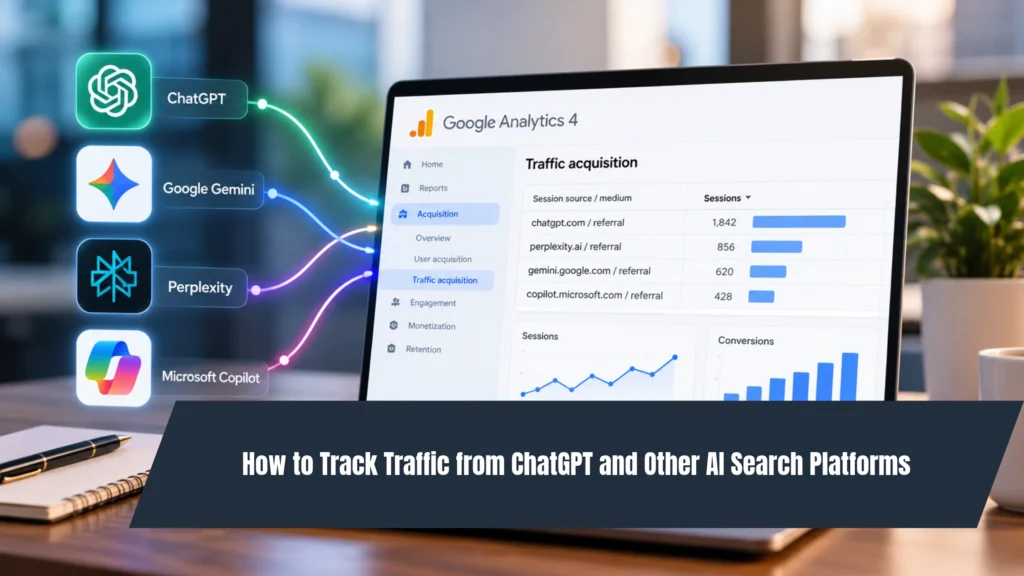
AI tools are becoming another way for people to discover businesses online. A potential customer might ask ChatGPT to find an SEO specialist, use Perplexity to compare digital marketing services, or consult another AI assistant before visiting a company’s website.
For businesses, an important question is whether these interactions lead to website visits and genuine enquiries.
Google Analytics 4 (GA4) can help identify visits from AI platforms when referral information is available. By reviewing traffic sources, landing pages, and conversion activity, businesses can assess whether AI-driven visits contribute to their marketing goals.
Understanding AI Referral Traffic
AI referral traffic is website traffic attributed to an AI platform when a user follows a link to your website.
Consider a business in Calicut offering website development services. Someone asks an AI assistant to suggest local web development providers and clicks a link to that business’s website. If the visit’s referral information is recorded, the business may be able to identify the AI platform in its analytics reports.
There are three related concepts to understand:
- AI referral traffic: Visits to your website attributed to an AI platform.
- AI brand mentions: Occasions when an AI-generated answer names your business.
- AI search visibility: How your business appears in AI-generated responses across relevant queries.
These measurements are not interchangeable. A business can receive an AI mention without gaining a website visit.
Why AI Traffic Measurement Matters
Understanding how visitors arrive at your website can help you make better marketing decisions.
Tracking AI referral traffic can help businesses:
- Identify AI platforms that send website visitors.
- Discover which blog posts and service pages attract those visitors.
- Understand whether visitors explore the website or leave quickly.
- Measure enquiries and other important actions.
- Identify content opportunities based on observed user behavior.
The objective is not simply to increase traffic. It is to understand whether the visitors are relevant to your business.
How to Find AI Traffic in Google Analytics 4
GA4 offers a practical way to investigate identifiable visits from AI platforms. Follow these steps to examine your website data.
1. Check Your GA4 Setup
Open your Google Analytics account and select the property associated with your website. Confirm that data collection is working and that important conversion events have been configured.
Without reliable tracking, your reports may not reflect actual website activity accurately.
2. Review the Traffic Acquisition Report
In GA4, open Reports → Acquisition → Traffic acquisition.
This report helps you examine the sources associated with website sessions.
3. Search for AI Referral Sources
Review the Session source / medium dimension. Depending on the information available, you may find source values associated with platforms such as:
- chatgpt.com
- perplexity.ai
- gemini.google.com
- copilot.microsoft.com
These examples are starting points, not an exhaustive list. Source information can vary, and some visits may not be attributed to an AI platform.
4. Identify the Pages Receiving Visits
Next, examine the landing pages associated with AI-referred sessions.
For example, a Kerala digital marketing company might discover that a blog explaining local SEO attracts visitors from an AI assistant. The company can then investigate whether those visitors continue to its service pages or contact the business.
This helps connect content performance with potential business opportunities.
5. Check Enquiries and Conversions
Review the conversion events configured in GA4, such as contact form submissions, consultation requests, or clicks on telephone links.
Make sure these events represent meaningful actions and are being recorded correctly. A visit should not automatically count as a lead simply because someone viewed a service page.
Important Metrics for Evaluating AI Traffic
Businesses can use several metrics to understand the value of AI-referred visits.
| Metric | What it tells you |
| AI-attributed sessions | How many sessions are linked to identifiable AI sources |
| Landing pages | Which pages receive those visits |
| Engagement | How visitors interact with the website |
| Conversions | How many tracked actions visitors complete |
| Conversion rate | The proportion of sessions or users completing a defined action |
| Lead quality | Whether enquiries develop into genuine business opportunities |
For example, a service page that attracts fewer AI-referred visitors but generates relevant enquiries may be more valuable to a business than a blog that receives many visits without producing meaningful actions.
Challenges in Tracking AI Search Traffic
AI referral data provides useful insights, but it does not show the entire customer journey.
Missing referral details: Some visits may be recorded as direct traffic when source information is unavailable.
Cross-channel journeys: A customer might discover a company through AI and return later through Google Search or social media.
Limited data: Low referral volumes can make short-term comparisons unreliable.
Different reporting classifications: Analytics may classify visits differently depending on available source information and reporting configuration.
Untracked AI mentions: GA4 cannot show every instance in which an AI platform mentions your business without sending a visitor.
For these reasons, referral traffic should be measured separately from broader AI search visibility.
Best Practices for AI Search Measurement
To build a more reliable reporting process:
- Verify that GA4 is collecting data correctly.
- Configure and test important conversion events.
- Review AI-related sources at regular intervals.
- Compare consistent reporting periods.
- Identify landing pages that attract relevant visitors.
- Compare analytics findings with actual customer enquiries.
- Monitor AI brand mentions separately from website traffic.
Businesses should also publish accurate, original content that clearly explains their services, expertise, and location. This supports a useful online presence, although it cannot guarantee inclusion in AI-generated answers.
Frequently Asked Questions
Can GA4 track traffic from ChatGPT?
Yes. GA4 can identify visits attributed to ChatGPT when the necessary referral information is available. Check the Traffic acquisition report for relevant source values.
Does AI referral traffic improve Google rankings?
Not automatically. AI referral traffic helps measure a source of website visits, while Google rankings depend on multiple factors, including content relevance, quality, and technical accessibility.
Can I measure AI mentions without website visits?
Not through GA4 alone. Analytics records website activity, so broader AI visibility requires separate monitoring of brand mentions and citations.
Is AI referral traffic the same as AI search visibility?
No. Referral traffic measures identifiable website visits. AI search visibility describes how a business appears in AI-generated answers, including mentions that do not produce clicks.
Conclusion
AI platforms offer another possible route for people to discover businesses online. By using GA4 to investigate identifiable referral sources, landing pages, engagement, and conversions, businesses can better understand how these visits contribute to their marketing objectives.
Combining analytics with useful content, technical SEO, and lead tracking provides a more complete view of online performance.
Al Katef IT Solutions helps businesses strengthen their digital presence through SEO and digital marketing services.
Looking to improve your website’s visibility and generate more enquiries? Visit https://alkatefitsolutions.com/ to explore our services.
