

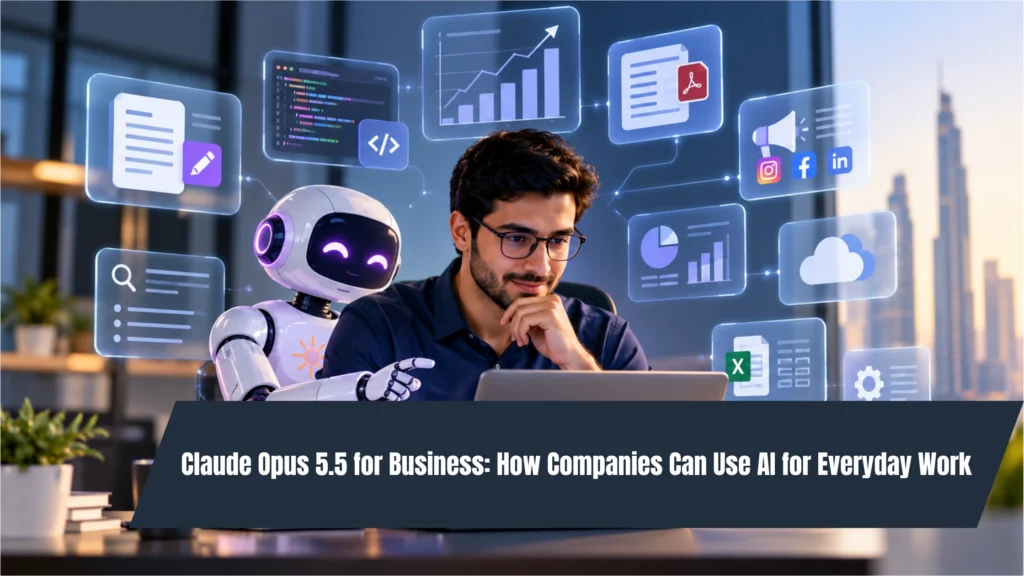
Artificial intelligence is becoming less about asking questions and more about getting work done.
Businesses are now exploring AI for software development, research, reporting, document preparation, data analysis, and tasks that normally require several steps. This shift is creating new possibilities for companies that want to improve productivity without changing their entire operation overnight.
One of the latest developments is Claude Opus 5.5, introduced by Anthropic in September 2026. The model is positioned for coding, knowledge work, computer use, and agent-based workflows. Anthropic also says Opus 5.5 costs about 40% less to run than Opus 5 on typical token-billed workloads.
For business owners, the interesting question is not simply what the model can do. It is where AI can make everyday business work easier, faster, or more organized.
Why Claude Opus 5.5 Is Getting Attention
Claude Opus 5.5 is designed for work that can involve multiple stages and extended interaction with tools.
Anthropic highlights areas including agentic coding, enterprise workflows, financial analysis, knowledge work, and computer use. The company also describes capabilities for working with documents, charts, spreadsheets, presentations, and complex software projects.
This makes the technology relevant beyond content generation.
A company could potentially use AI to assist with a project from the initial research stage through analysis and documentation, while employees remain responsible for reviewing the work and making decisions.
Everyday Business Tasks AI Can Support
Not every business needs a complicated AI system.
Many opportunities can be found in ordinary tasks that employees perform repeatedly.
For example, AI can help teams:
- Organize research material
- Summarize lengthy documents
- Prepare first drafts of reports
- Review and explain data
- Develop software features
- Analyze business information
- Create presentation drafts
- Assist with repetitive computer tasks
The benefit comes from reducing the amount of time employees spend moving information from one step to another.
AI for Research and Decision Support
Business research can involve a large amount of reading and information management.
Imagine a company considering a new service. The team may need to examine competitors, customer expectations, industry developments, pricing information, and existing internal data.
Claude Opus 5.5 can be used as an assistant during this process to organize information and help structure research.
The important distinction is that AI-generated research should be treated as input for decision-making, not as the decision itself.
Employees should verify important facts, check sources, and apply their knowledge of the market before acting on the results.
AI for Software and Technical Teams
Software development is one of the areas where Claude Opus 5.5 is particularly relevant.
Anthropic describes it as its strongest Opus model for agentic coding, with capabilities for working across large codebases, building features, debugging, refactoring, and code review.
For a development team, this could mean using AI to assist with tasks such as:
- Understanding an existing codebase
- Finding potential bugs
- Creating or modifying features
- Reviewing code
- Preparing technical documentation
- Investigating implementation issues
The developer still needs to review changes, test the software, and decide whether the proposed solution is appropriate.
AI can reduce repetitive development work, but software quality still depends on proper engineering practices.
AI for Marketing Teams
Marketing is another area where businesses can introduce AI without completely changing their existing strategy.
A Digital Marketing Agency in Calicut can use AI-assisted workflows for research, content planning, campaign analysis, reporting, and idea development.
For example, marketers could use AI to:
- Explore customer questions
- Generate initial content concepts
- Organize campaign information
- Summarize performance reports
- Develop advertising variations
- Research topics
- Structure marketing presentations
The human marketing team remains responsible for deciding what fits the brand and audience.
This is important because good marketing is not simply about producing more content. It requires understanding customer behaviour, positioning, messaging, creativity, and business objectives.
Claude Opus 5.5 and SEO
SEO is also becoming more connected with AI-assisted workflows.
An SEO agency in Calicut can use AI to support tasks such as topic research, content planning, competitor analysis, search-intent exploration, and reporting.
For example, instead of manually organizing hundreds of customer questions, a marketing team could use AI to group them into broader topics and identify possible content opportunities.
However, AI should not be used to create large amounts of repetitive content simply for search engines.
Useful SEO still depends on:
- Search intent
- Helpful information
- Technical website quality
- Relevant internal linking
- Local relevance
- Accurate business information
- Strong user experience
AI can make the research and planning process more efficient, but the strategy still needs to be based on real customers and business goals.
AI for Reports, Documents and Presentations
Many employees spend considerable time preparing internal documents.
Monthly reports, project summaries, proposals, meeting notes, presentations, and business updates often involve collecting information from several places.
AI can help turn that information into a structured first draft.
For example:
Raw information → AI-assisted organization → Draft report → Human review → Final document
This approach can save time while keeping an employee responsible for accuracy and the final message.
Claude Opus 5.5 is specifically positioned for professional workflows and can work with spreadsheets, slides, and documents.
AI for Customer and Business Operations
Customer-facing teams can also benefit from AI-assisted workflows.
Consider a company receiving dozens of enquiries every day. Employees may need to read each message, identify the customer’s requirement, collect relevant details, and forward the request to another team.
AI could help organize this information before a person takes over.
For example:
Customer enquiry → Information organized → Request categorized → Team reviews → Customer receives response
The exact workflow will depend on the company’s software and processes.
The important point is that AI can take care of certain information-handling steps while people remain involved where judgment and customer interaction matter.
AI and Computer-Based Work
One of the more interesting developments in advanced AI is the ability to interact with computer environments.
Claude Opus 5.5 is described by Anthropic as its strongest Opus model for computer use, including tasks that involve multiple applications and visual information such as documents, charts, screenshots, and diagrams.
For businesses, this could eventually reduce the amount of manual clicking and information transfer required for certain digital workflows.
However, computer-use automation should be introduced carefully. Companies need appropriate permissions, security controls, monitoring, and human oversight for important operations.
How Small Businesses Can Start
A small business does not need to automate everything.
A practical starting point is to identify one repetitive activity.
For example:
- A marketing team spends hours preparing weekly reports.
- A sales team repeatedly summarizes customer enquiries.
- A developer spends time investigating similar coding issues.
- A manager manually organizes information for presentations.
- An operations team repeatedly moves data between systems.
Choose one of these tasks and test whether AI can reduce the workload.
If the results are useful, the business can gradually expand the workflow.
What Businesses Should Consider Before Using AI
Start With the Workflow
Choose the business process first and the AI tool second. This helps prevent unnecessary technology adoption.
Protect Sensitive Information
Businesses should understand what data is being processed and establish appropriate access and security controls.
Review the Output
AI can make mistakes. Important information should be checked before being used in customer communication, reports, financial work, or business decisions.
Measure the Results
Look beyond the novelty of AI. Track practical outcomes such as time saved, productivity, quality, cost, and employee workload.
Keep People in Control
AI can handle parts of a workflow, but people should remain responsible for important decisions, approvals, and business outcomes.
Is Claude Opus 5.5 Useful for Every Business?
Not necessarily.
A company with mostly manual paperwork may have different AI opportunities from a software company. A marketing agency may benefit from research and reporting assistance, while an engineering company may focus more heavily on coding and technical workflows.
The right question is therefore not:
“How can we use Claude everywhere?”
A better question is:
“Which part of our work could become easier with AI?”
That approach makes AI adoption more practical and easier to measure.
Common Questions About Claude Opus 5.5
What can Claude Opus 5.5 do for businesses?
It can support areas such as coding, knowledge work, research, computer use, enterprise workflows, financial analysis, and other complex professional tasks.
Can Claude Opus 5.5 help with marketing?
Yes. Businesses can use it to support research, content planning, reporting, analysis, and other marketing workflows. Human review and strategy remain important.
Can Claude Opus 5.5 help with SEO?
It can assist with research, topic organization, content planning, analysis, and reporting. SEO decisions should still be based on search intent, website data, technical factors, and business objectives.
Is Claude Opus 5.5 suitable for small businesses?
Small businesses can explore it for focused tasks where AI may reduce repetitive work or help employees handle information more efficiently.
Can AI completely automate a business?
AI can automate parts of certain workflows, but complete automation is not appropriate for every task. Security, accuracy, human approval, and business requirements need to be considered.
Building a Practical AI Strategy
Claude Opus 5.5 represents a broader shift in business technology. AI is moving beyond simple conversations and into workflows involving research, software, documents, analysis, and computer-based tasks.
For businesses, this creates an opportunity to rethink repetitive work.
Instead of replacing an entire process, companies can start by improving one part of it. A small improvement in reporting, research, content planning, coding, or administration can eventually become part of a larger AI-supported workflow.
The most useful AI strategy is therefore not about using the newest technology everywhere. It is about finding the places where technology can create meaningful business value.
Take the Next Step With AI
AI can help businesses reduce repetitive work, support employees, improve marketing workflows, and organize complex information.
Looking to combine AI with digital marketing, SEO, web development, and modern technology solutions? Connect with Al Katef IT Solutions to explore practical strategies built around your business requirements.
