

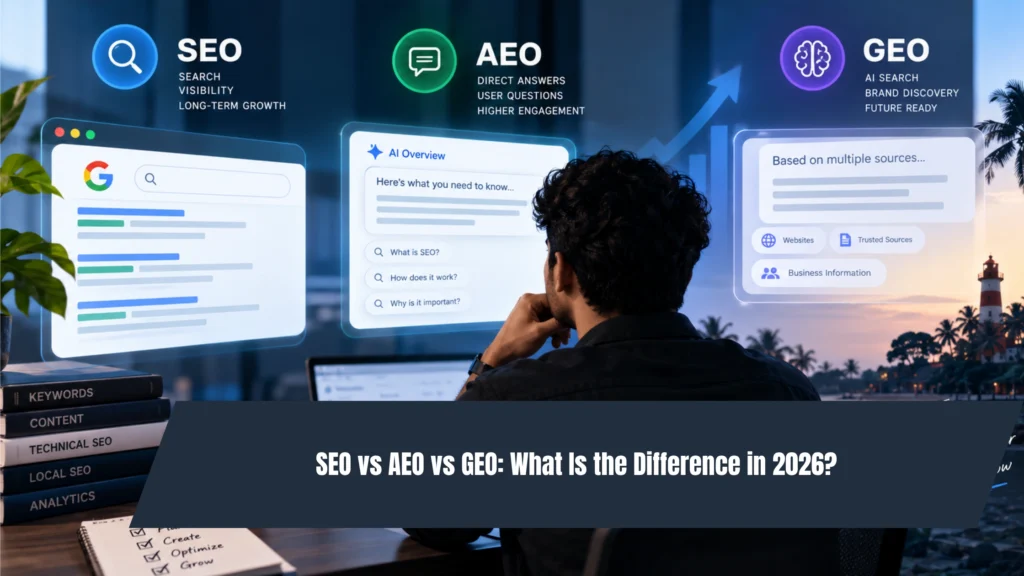
Search is changing rapidly. People are no longer using search engines only to find a list of websites. They are asking complete questions, looking for direct answers, comparing businesses, and using AI-powered search experiences to discover products, services, and information.
This shift has made terms such as SEO, AEO, and GEO increasingly important in digital marketing.
Although these approaches have different focuses, they are closely connected. Understanding the difference between them can help businesses across Kerala create content that works across traditional search and newer AI-powered experiences.
What Is SEO?
SEO, or Search Engine Optimization, is the process of improving a website so search engines can understand its content and users can discover it through relevant searches.
SEO can include keyword research, on-page optimization, technical SEO, internal linking, content optimization, local SEO, website performance, and search performance analysis.
For example, a digital marketing business in Calicut may create a service page about SEO, optimize it for relevant search intent, improve its technical structure, and publish supporting content.
Modern SEO is not simply about adding keywords. Search engines need to understand the topic, purpose, quality, and usefulness of a page.
What Is AEO?
AEO, or Answer Engine Optimization, focuses on creating content that directly answers questions people ask.
Instead of targeting only a phrase such as “SEO services,” AEO considers questions like:
- What does an SEO agency do?
- How long does SEO take?
- What is local SEO?
- How can SEO help a small business?
Clear headings, direct answers, FAQs, explanations, and useful examples can make content easier for users and search systems to understand.
AEO is not a replacement for SEO. The two can work together, with SEO providing the broader search foundation and AEO focusing more strongly on answering specific questions.
What Is GEO?
GEO, commonly used to mean Generative Engine Optimization, refers to efforts aimed at improving how information can be discovered, understood, and potentially represented in generative AI search experiences.
Traditional search may present users with a list of web pages. AI-powered search can instead combine information from different sources and provide a conversational response.
Because of this, clear context becomes increasingly important.
A business should clearly communicate its services, location, expertise, products, and other important information across its digital presence.
GEO is still an evolving concept, so businesses should be careful about claims that there is one fixed formula for appearing in AI-generated answers.
SEO vs AEO vs GEO
The three approaches can be understood simply:
| Approach | Main Focus | Primary Purpose |
| SEO | Search engines and websites | Improve organic search visibility |
| AEO | Questions and answers | Provide clear, useful answers |
| GEO | Generative AI experiences | Improve discoverability and contextual understanding |
These approaches should not necessarily be treated as three completely separate strategies.
A website with useful content, clear information, good structure, and strong technical foundations can support all three.
How SEO, AEO, and GEO Work Together
Imagine a digital marketing agency serving businesses in Calicut.
For SEO, the agency could create an optimized service page targeting relevant searches related to digital marketing and SEO.
For AEO, it could publish answers to questions such as “What does a digital marketing agency do?” or “How much does SEO cost?”
For GEO, the agency could clearly communicate its services, location, expertise, business information, and supporting content across its digital presence.
The same high-quality content can therefore support different ways of discovering information.
The goal is not to create three versions of the same page. Instead, businesses should create useful information that can be understood by both people and different search systems.
Why Search Intent Matters
Search intent is an important connection between SEO, AEO, and GEO.
Someone searching for SEO agency in Calicut may be looking for a service provider, while someone searching for “what is SEO?” is probably looking for an explanation.
These users have different needs.
Understanding search intent helps businesses decide whether they need an educational article, service page, comparison, local landing page, product page, or direct answer.
When content matches what users actually want, it can provide more value than content created simply to include a keyword.
Content Quality Still Matters
The growth of AI search does not mean businesses should publish large amounts of automatically generated content.
Google’s spam policies warn against creating large amounts of unoriginal content primarily to manipulate search rankings, including scaled content abuse involving AI or other systems.
For businesses, this means quality should come before quantity.
Useful content should provide accurate information, practical examples, original insights, and a clear reason for readers to trust it.
Businesses can also strengthen their content by sharing genuine experience, case studies, industry knowledge, and information that helps customers make better decisions.
Why Websites Still Matter
The growth of AI search does not make business websites irrelevant.
A website remains an important source of information about a company. It should clearly explain:
- What the business does
- Which products or services it provides
- Where it operates
- Who it serves
- How customers can contact it
Technical accessibility is also important. A website should be mobile-friendly, easy to navigate, fast, secure, and accessible to search engines.
Internal linking, clear page structure, and structured data can also help organize important information.
SEO, AEO, and GEO for Kerala Businesses
Businesses across Kerala are using digital channels to reach local customers as well as audiences outside the state. As search becomes more conversational and AI-powered, businesses need to make their online information clear, useful, and consistent.
For example, a Digital Marketing Agency in Calicut can create location-specific service pages, answer common customer questions, publish useful industry content, and maintain accurate business information across relevant platforms.
A Kerala business can use SEO to improve visibility in Google Search, AEO to provide direct answers to customer questions, and GEO to provide clear business context for AI-powered search experiences.
Local relevance is especially useful for businesses that depend on customers within a specific city or region.
Example: Using All Three for One Business
Imagine a web development company serving customers across Kerala.
For SEO, it could create a detailed service page about website development and optimize it around relevant search intent.
For AEO, the company could answer questions such as:
What should a business website include?
How long does website development take?
For GEO, the company could clearly explain its services, location, experience, industries served, and business information across its website and relevant online platforms.
One well-planned content strategy can therefore support multiple discovery paths.
How Businesses Can Prepare for 2026
Businesses do not need to abandon SEO and completely switch to AEO or GEO.
Instead, they can strengthen the fundamentals that support all three approaches.
Create useful content: Answer genuine customer questions with accurate and practical information.
Understand search intent: Match each page to what users are actually trying to accomplish.
Improve website quality: Maintain a fast, mobile-friendly, accessible, and easy-to-navigate website.
Build topical depth: Cover important subjects related to your products, services, and industry.
Strengthen business information: Keep company details, services, locations, and other important information clear and consistent.
Show genuine expertise: Add original examples, case studies, experience, and useful insights where appropriate.
Measure meaningful results: Look beyond rankings and track relevant traffic, enquiries, conversions, and other business outcomes.
Common Questions About SEO, AEO, and GEO
Is AEO replacing SEO?
No. AEO focuses on providing useful answers, while SEO covers broader search optimization. They can work together as part of one strategy.
Is GEO the same as SEO?
No. GEO generally refers to generative AI search experiences, while SEO traditionally focuses on search engine visibility. However, they share several important fundamentals.
Do businesses need separate SEO, AEO, and GEO strategies?
Not necessarily. A strong website and content strategy can support all three. Useful content, clear information, technical accessibility, and search intent remain important.
Does AI search make traditional SEO unnecessary?
No. SEO fundamentals remain relevant as search continues to introduce AI-powered experiences. Businesses should continue focusing on useful content, technical accessibility, and a good user experience.
Building a Modern Search Strategy
SEO, AEO, and GEO should not be viewed as competing marketing methods.
SEO helps businesses improve visibility in traditional search.
AEO focuses on providing clear and useful answers.
GEO considers how information can be discovered and understood within generative AI experiences.
For businesses in Kerala, the focus should be on creating useful, trustworthy, accessible, and well-structured information rather than trying to manipulate individual algorithms.
As search continues to move from traditional results toward answers, conversations, and AI-powered experiences, businesses that build strong digital foundations will be better prepared for the changing search landscape.
